

Tips for Buying Vintage Graphic Tees Online
Last Updated: November 8, 2026
Quick Summary
To buy vintage graphic tees online safely, ignore the size tag and compare pit-to-pit and length measurements with a shirt you already own. Then check stitching, fabric and tag details for signs of an original rather than a reprint, and judge condition closely before paying.
- Vintage sizing differs from modern sizing, so a 1990s "L" often fits like a modern M.
- Compare pit-to-pit and garment length measurements against a shirt you already own.
- Look for a single-stitch hem on the sleeves and bottom, a sign of older production.
- Ask sellers for close-up photos of the tag, hem and print before buying.
- Compare recent sold listings, since vintage band tees can be priced far above their condition.
Table of Contents
- How to Choose the Right Shirt Size From Listing Photos and Measurements
- How to Tell Authentic Vintage T-Shirts From Reprints
- Checking Condition, Price, and Vintage Band Tees Before You Click Buy
- Frequently Asked Questions
Buying a vintage graphic tee online can feel like a gamble: one listing shows a faded shirt with a great print, the next shows a similar shirt at triple the price. Here's how to tell the difference before you click buy, starting with the one thing sellers get wrong most often: size.
How to Choose the Right Shirt Size From Listing Photos and Measurements
Vintage sizing does not match modern sizing. A tag that says "L" from the 1990s often fits like a modern M. Ignore the tag and check the measurements instead.
Look for a pit-to-pit measurement (armpit to armpit, laid flat) and a garment length, then compare those numbers to a shirt you already own and like. For a deeper look, read our guide on how to choose the right shirt size.
Unisex sizing also trips up many shoppers, especially women. Our sizing guide on whether unisex shirts fit women well explains what to expect.
How to Tell Authentic Vintage T-Shirts From Reprints
Reprints are common. Many modern shirts copy old designs, so the print alone does not prove age.
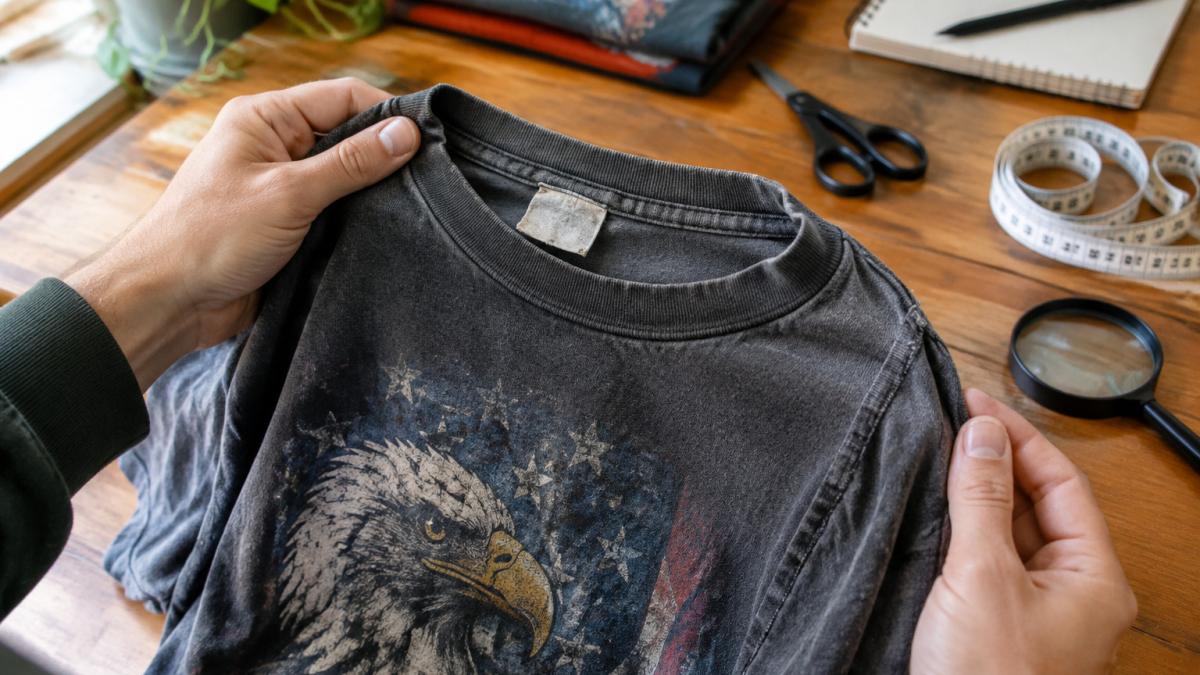
Check the fabric, tag and stitching: a single-stitch hem on the sleeves and bottom, thin soft cotton, and a tag matching the era. Tags with fine, uneven print often point to older shirts. For more, see our cotton quality checks and our guide to spotting original designs.
Ask the seller for close-up photos of the tag, hem and print to spot genuine wear patterns.
The article lists several details that help separate older shirts from modern reprints.
| Check | What to look for | Why it matters |
|---|---|---|
| Sleeve and hem stitching | Single-stitch hem | Points to older production |
| Fabric | Thin, soft cotton | Common in vintage shirts |
| Tag | Fine, uneven print | Often signals an older shirt |
| Genuine wear patterns | Shows real age, not a copy | |
| Seller photos | Close-ups of tag, hem and print | Lets you verify before buying |
Checking Condition, Price, and Vintage Band Tees Before You Click Buy
Condition matters more than age. Check for holes, stains, fading and cracking on the print; our care tips for graphic tees can help you judge how a shirt has been treated.
Vintage band tees can cost far more than their condition justifies, so compare recent sold listings before you buy.
Shop patiently, because the best vintage graphic tees usually come from sellers who post clear photos and honest descriptions.
Shopping for vintage tees should be fun, not stressful. Use these checks on every listing, and you will buy with more confidence. Browse StumbleRump's collection of funny party tees for bold, new graphics that stand out at your next gathering.
Frequently Asked Questions
Where are the best online stores for buying vintage t-shirts?
Marketplaces such as eBay, Etsy, and Depop list large volumes of vintage tees from individual sellers, while specialist vintage shops often curate tighter selections with better photos. Compare seller ratings, return policies, and listing detail before you buy. Look for sellers who post multiple angles, flat measurements, and close-ups of the print and tag. Pricing varies widely with demand, condition, and era, so check recent sold listings to gauge what a tee is actually worth.
How can you tell if a vintage graphic T-shirt is authentic?
Start with the tag and stitching. Many older shirts from the 1980s and early 1990s have single-stitch hems on the sleeves and bottom, and the tag style often matches the brand's known era. Check the print for cracking, soft ink, and natural fading, since many reprints look too crisp. Ask the seller for a close-up of the tag and hem, and compare the print to documented originals from the same brand.
How do you find the right size when buying vintage T-shirts online?
Vintage sizing runs differently from modern sizing, so a tag size of Large may measure much smaller than a current Large. Ask for pit-to-pit and garment length measurements taken flat, and compare them to a favorite tee you already own that fits well. Keep in mind that cotton can shrink after washing, so size up if the tee is pre-shrunk or unknown. Check the seller's return policy before ordering, since fit uncertainty is common with vintage pieces.
